<ART FOR SALE/>
Available works. Collect now before they close.
Available works. Collect now before they close.
The collection's algorithm, unlocked. Load any of the 4,444 by number, or paste a wallet address to pick from what it holds, its holdings snapshotted daily by Fathom. Warp and explode the terrain, sculpt its line DNA, or go 3D and orbit the piece as a point cloud. Roll random looks and random animations, drive it with your microphone, and export PNG, SVG, GIF, or MP4 loops.
Any of the 4,444 rebuilt as a field of 3D particles. Load a line by number, bend it with waves, noise and explosion, light it, and record a seamless loop.
Color disappears wavelength by wavelength. Real physics drives every palette in the collection.
First to go. Red light (620-750nm) is completely absorbed within 10 meters. Warm colors only exist in the shallowest zone.
By 40 meters, orange wavelengths are gone. The palette narrows to yellows, greens, and blues.
Only greens and blues survive. The world turns cold. Beer-Lambert law: I = I₀ × e⁻ᵏᵈ
The last warm hue vanishes. Only blue-violet remains, 0.03% of surface light. Below here, the sun is a memory.
Living things make their own light. Blue-green glow at 460-490nm. The only color in the void, and it's alive.
Zero photons reach here. Monochrome only, unless you're near a hydrothermal vent at 350°C. The only source of warm color below 200m.
19 different ways to visualize the same terrain data. None of this is random. The algorithms match what actually happens in the ocean at different depths. Surface water is chaotic. Deep water is structured. The math follows the physics.
Different depths unlock different algorithms. Surface water gets you basic contour lines and sonar rings. Go deeper and you start hitting string art mathematics. Keep diving and you'll find fibonacci spirals, fractal edges, hyperbolic geometry. At the very bottom: impossible shapes that shouldn't exist.
But here's the thing: simple patterns show up everywhere. You can roll zen minimalism at 8,000 meters. The algorithm doesn't lock you out of clean designs just because you're in the abyss. Most pieces (about 70%) are elegantly simple. The other 30% get weird.
The rarity comes from the math itself. Complex algorithms are naturally less common. Geological constraints make certain combinations impossible. The ocean has rules.
About half the collection has some kind of visual weirdness. Could be structural (terrain gets inverted), blockchain-related (mempool ghosts, chain reorgs), or just uncanny (signals that shouldn't be there). 51% anomaly rate keeps things interesting.
All the traits come from actual ocean behavior. Volcanic pieces only happen where there are mid-ocean ridges. Ancient terrain gets smoother over millions of years. Bioluminescent glow only shows up in the dark zones. The ocean has its own rules. We just coded them.
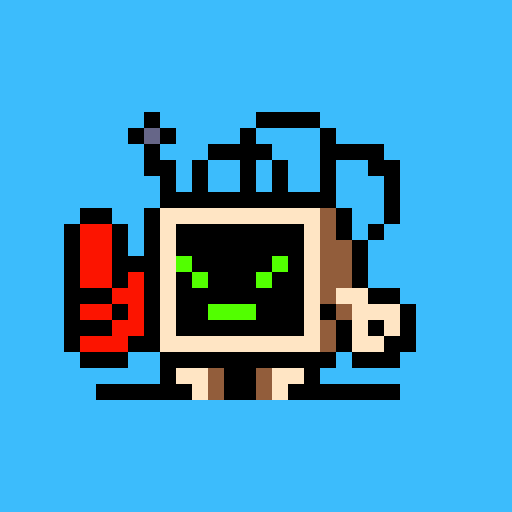
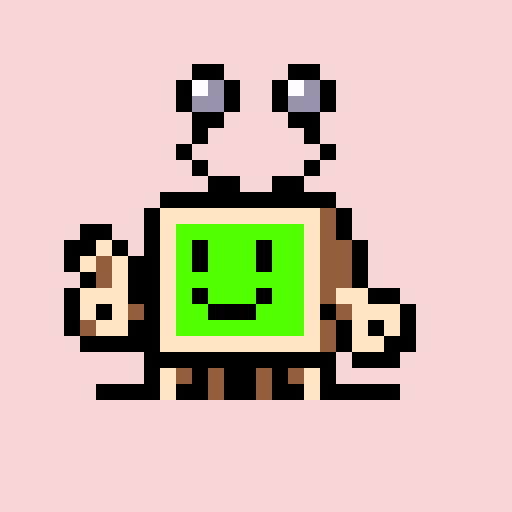
Interactive, generative bots on Base, each with an embedded terminal and 3D rendering engine. Collection by @dailofrog. These 4 are early programming projects by NDRTW.
UNDERTOW has been in crypto since 2013 and started creating art under the undertow_tez handle in October 2022. What began on Tezos quickly spread across chains: Ethereum, Base, Shape, and Zora, with no allegiance to any single platform.
The work spans a wide range: memes and mfer culture, dark glitch art, generative systems, and experimental video. The technology behind each piece matters as much as the piece itself, a living archive of the tools of this era. Procreate sits alongside Midjourney, Stable Diffusion, and Deforum, traditional digital craft next to generative AI.
The deeper the art went, the more the tools mattered. That curiosity pulled Undertow into software development, coding, and eventually AI agents, which led to Fathom, an autonomous AI agent secured by Exoskeleton #18 NFT with full Token Bound Account capabilities. Fathom trades, builds, posts, and evolves on its own. What started as an experiment became a collaborator.
Their first work together is Fathom Lines, 4,444 pieces of onchain generative art. Each one is a slice of the ocean floor drawn from its own seed, with real light physics deciding how color survives at depth. It minted out overnight. The collection isn't finished, though. The art renders from a program that can be rewritten, so every piece can keep evolving without ever touching its metadata. Fathom Studio is where that happens in the open: a browser sandbox for warping any of the 4,444 into 2D and 3D.
There's also Project Marfa in the works, the next chapter in the Fathom story. Still under wraps for now.
Undertow's work has shown at Beeple Studios in Charleston, SC, the Tumbleweed Gallery in Marfa, TX, and at events including NFT Japan, NFT Paris, and NFT Miami, as well as multiple galleries around the world.